Showing posts with label Extra. Show all posts

Monday, May 7, 2012

News: RM820m claims to drive up Bakun Dam costs


KUALA LUMPUR, May 7 — Officially priced at RM7.46 billion, the Bakun hydroelectric dam project in Sarawak is likely to rocket again as contractors claim a whopping RM820 million from its chief promoter, state-owned Sarawak Hidro Sdn Bhd, The Edge Financial Daily reported today.
However, the final price for the long-delayed dam project is yet to be determined.

A joint-venture company led by Sime Darby, the Malaysia-Sino Hydro Corp joint Venture (MCHJV), has put in claims totalling RM670 million for civil works while another consortium of contractors supplying turbines led by Argentina’s IMPSA group is seeking to claim RM140 million, the daily reported, quoting financial executives close to the project.

It also reported government sources familiar with the ongoing negotiations as saying that Sarawak Hidro, a wholly-owned subsidiary of the Finance Ministry, is willing to pay just over RM100 million while its consultants, who were unnamed, disclosed that IMPSA’s claims have been rejected.

“Both claims are still subject to negotiations between Sarawak Hidro and the respective parties. Ultimately the decision will come from the Finance Ministry,” the paper reported an unnamed senior construction industry executive involved in the project as saying.

The latest claims come at a time when Sarawak Hidro is desperately looking for buyers for power to be generated by the dam, the daily reported.

Rio Tinto, the world’s third largest miner, and Cahya Mata Sarawak, a financial and construction conglomerate based in Sarawak, announced on March 27 this year they have scrapped plans for a US$2 billion (RM6.1 billion) aluminium smelter project in Sarawak as power supply terms could not be finalised.

The aluminium smelter was to have been Bakun’s biggest customer, The Edge Financial Daily reported.

The dam project, first awarded to Ekran Bhd in 1994, was scheduled to have been completed in 2007 but has been plagued by various problems including the 1997 Asian financial crisis.

Inaccurate soil studies by Sarawak Hidro further complicated civil works portion of the dam, the business daily reported.

The mammoth project has also been downsized, with an undersea cable supplying power to Peninsular Malaysia scrapped.

http://www.themalaysianinsider.com/malaysia/article/rm820m-claims-to-drive-up-bakun-dam-costs/

Monday, March 26, 2012

News: Bakun’s reservoir now as big as Singapore


FULL LEVEL: The most recent photo of the reservoir at Bakun Dam

KUCHING: The impoundment of the Bakun Dam reservoir, which commenced on October 13, 2010, has reached the full supply level of 228m above sea level (asl) as of last Friday.

Sarawak Hidro Sdn Bhd (SHSB) managing director Zulkifle Osman said the size of the reservoir was now over 695 square kilometres, which is a water body equivalent to 
the size of Singapore.

Despite this, he said based on SHSB’s spillway operation rule, the reservoir would have to be lowered six metres to eight metres below the full supply level.

It has to be maintained at this level until such time the Sarawak Electricity Supply System load increases to allow the reservoir to operate over its full range, he added.

The additional release for reservoir lowering is scheduled to commence today.

“The lowering of the reservoir level also serves as an important purpose in providing flood storage of the reservoir, and hence reducing the peak spillway discharges during floods, thereby regulating floods downstream,” he said in a statement.

He also mentioned that since November 11 last year, Bakun Dam has been continuously releasing about 500 cubic metres per second (m3/s) of water through its spillway, and up to 300 m3/s from the powerhouse for power generation to enable unrestricted river traffic, especially for passenger express boats travelling between Kapit, Belaga and Bakun.

As for today’s scheduled reservoir lowering, he said the total discharge  downstream would be three times more, at 2,500 m3/s.

“This is approximately 1.6 times the long term average flow of Batang Balui (1,500 m3/s), but much lower than high flow of the river. It is anticipated that with this additional discharge, the downstream river level will rise further, and the river flow will become swifter.

“As such, river users and inhabitants downstream of the dam are hereby advised to take extra precautions on the rising river level and fluctuating river flows.”

He also said SHSB, as owners of Bakun Dam, wish to express their sincere appreciation to the downstream folks for their understanding and cooperation during the impoundment period.

“The downstream river users have benefitted from almost uninterrupted river travel.”


Read more: http://www.theborneopost.com/2012/03/12/bakuns-reservoir-now-as-big-as-singapore/#ixzz1qDG72CI7

News: Statistics show SCORE won’t benefit locals


KUCHING:  If the labour force survey statistics for 2008-2011 is any yardstick then Taib Mahmud’s  much touted Sarawak Corridor of Renewal Energy (SCORE) will be of no benefit to locals least of all the indigenous communities who will be left far behind.

According to Sarawak PKR chief Baru Bian the figures from the Department of Statistics  don’t offer any  indications that locals will enjoy the fruits from SCORE.

“This is because SCORE will need highly skilled labour force, and our people, especially those in the rural areas have little opportunities to complete their school studies and go on to tertiary level.

“From the labour force survey (2008-2010) of the Department of Statistics, out of Sarawak’s labour force, only 17% or 166,175 people have any form of post secondary education,” he said.

He added that even the projected figures for the labour force were dismal.

He pointed out that according to the ‘projections’ for 2011,  the number of ‘labour force with post secondary education’  would amount to 150,690 of which the Malay-Melanau comprise 33.4% and the Chinese 39.49%.

“The Ibans makeup only 15.50%  while the Bidayuh comprise 7.19% and the Orang Ulu only 4.38% of labour force with post secondary education.

“From the statistics above, clearly, our people, especially the indigenous people are in no position to take on the jobs that are purportedly going to be created by SCORE,” said Bian who is Ba Kelalan assemblyman.

He was commenting on recent reports here highlighting the plight of Sarawakian workers in Singapore and the loss of millions of ringgit from the state due to illegal foreign workers.

Raise education standards

He said state Minister Fatimah Abdullah’s comment that SCORE would create 290,880 jobs by 2015 and with the likelihood of this increasing to 662,065 jobs by 2020 was insignificant to Sarawakians who were ill-equipped to participate in the progress.

“Fatimah Abdullah said that the state has only 25% highly skilled workers to date and that by the year 2015, SCORE is expected to create some 290,880 jobs that would increase to 662,065 jobs by 2020.

“This is significantly higher than the figure from the Department of Statistics for 2008-2010.

“We will need around twice the number of skilled workers than will be available from the whole of our labour force.

“The government is actually looking at importing foreign labour to fill these vacancies.

“How is SCORE going to benefit the people, if this is the scenario?” asked Bian, pointing out that the state needed to refocus on the very basic foundation of a successful and vibrant society which is developing its education system.

He said poor education policies and amenities were the root cause of low education levels in the state.
“A PR (Pakatan Rakyat) government will ensure that every child is given the opportunity to further his or her studies.

“We will raise standards of teaching, provide training opportunities for teachers, and provide better and more vocational training for school leavers,” he said.

Better wages needed

On a related issue,  Bian reasoned that foreigners worked mainly in plantations and construction sites “owned or controlled” by Taib’s relatives, his cronies, Barisan Nasional politicians and their families and friends.

“They take the land from the locals for plantations, and then to add insult to injury, offer the lowest wages (around RM18 per day), which is grossly insufficient to sustain even one person, let alone a family.

On claims that Sarawakians were choosy with jobs Bian said that it was inevitable.

“We cannot blame the (our) people for not wanting these jobs. They have to go to West Malaysia, Singapore and further abroad to make a living.

“The point is that our people cannot even earn a living on the wages being offered here. Why should they just be content on earning a living?

“We should want them to thrive and prosper. The Indonesians live the most frugal lives here so that they can send to their families the little that they make.

“Our people have families to support, and hence have to seek greener pastures outside of Sarawak,” he said, pointing out that there are 112,209 legal foreign workers in Sarawak.

“That means there are 112, 209 jobs that could be given to locals, if they are paid decent wages which they can live on.

“Currently, money generated from plantations and construction projects end up in Indonesia as remittances of the labourers or in the pockets of those who steal from and cheat the rural people, ” he said.

He said the solution now is to raise the wages sufficiently so that people can have enough to live on comfortably and to aim for better futures for their children, instead of just struggling to eke out a living.

News: The Dam that Wouldn't Die

Sarawak’s politically motivated Bakun Dam has a new Australian friend to help keep it going


sarawak 


The resuscitation of the controversial Bakun Dam as the result of an agreement to build a nearby aluminum smelter is the latest chapter in a long running saga to push forward the environmentally sensitive project closely linked to the longstanding Sarawak chief minister, Abdul Taib Mahmud, and his family.


The mammoth dam, one of the cherished mega-projects of former Prime Minister Mahathir Mohammad, has already wiped out 23,000 hectares of virgin rainforest, delivered the timber into the hands of timber barons and displaced 9,000 indigenous people. It is also a textbook example of how the New Economic Policy, Malaysia’s affirmative action program to improve the economic wellbeing of its bumiputera, or ethnic Malay majority, instead concentrates riches in a few hands.


On August 7, Australia-based Rio Tinto Aluminum signed a deal with Malaysian conglomerate Cahya Mata Sarawak, whose principal stakeholders are members of the Taib Mahmud family, for a joint study to build a US$2 billion smelter in Similajau, near Bintulu, 80 km inland from the dam itself. Expected to open in 2010, it will be one of the largest in the world, with initial production capacity is projected at 550,000 tonnes a year with the capability to expand to 1.5 million tonnes later.


Rio Tinto, with its projected takeover of Alcan, Inc., of Canada, is already expected to become the largest aluminum producer in the world. The smelter, which will use power from the Bakun dam, is expected to be the fifth and biggest aluminum plant for Rio Tinto, its external affairs manager Jim Singer told The Associated Press. Rio Tinto picked Sarawak for the project due to strong government support, a credible local partner, abundant electricity supply from the Bakun dam and robust demand in the region, Singer said.


Critics are livid. In a forum early this month organized by the United Nations Development Program in Kuala Lumpur to mark World Indigenous Day, Colin Nicholas, the coordinator of the Center for Orang Asli (Indigenous People) told local reporters that "From our point of view, by allowing the Rio Tinto project to go ahead, it is just like trying to cover up one natural disaster with another.”


“There was no open tender for the (aluminum smelter project) and no public announcement of it,” fumed opposition leader Anwar Ibrahim in an email to Asia Sentinel. “Combined, the smelter and the dam raise serious concerns about environmental impacts and the treatment of indigenous populations.”


Just as disturbing, to some observers, is the way Cahya Mata Sarawak, which means “light of Sarawak’s eye” in English and goes by the acronym CMS, has maneuvered itself into position to benefit from the dam.


Begun in 1974 under the name Cement Manufacturers Sarawak Bhd, the company originally produced Portland cement as a state-owned firm. Its transformation has been remarkable, according to a doctoral thesis submitted to the University of London in 2002 by Andrew Aeria, currently a lecturer in the Faculty of Social Sciences at the University Malaysia Sarawak in Kuching.


“The rapid growth and transformation of CMS since the 1990s has been nothing short of phenomenal, and is due to two main factors, namely the privatization and restructuring of CMS from a state-owned public-listed company into a private sector public-listed conglomerate owned by the Mahmud family, and the huge amount of state rents CMS secured for itself and its subsidiary companies from 1992 through political patronage,” Aeria wrote.


Aeria’s study tells the story in voluminous detail. Beginning in the early 1990s, Cement Manufacturers Sarawak Bhd, a state-owned company, bought major stakes in three highly profitable subsidiaries of the Sarawak Economic Development Commission – PPES Quarry, Steel Industries Sarawak and PCMS, for 117.4 million Malaysian ringgit, 50 million of that in cash, the rest covered by 13.48 million shares. For that, CMS got, in addition to the assets, 30.94 million ringgit in cumulative retained profits, according to the company’s annual reports. That moneyproved helpful, allowing CMS to acquire two other companies owned by the Mahmuds, namely Syrakusa Sdn Bhd and Concordance Sdn Bhd, via cash and share swaps. This resulted in the "privatization to the Mahmud family via a reverse takeover. Bank Utama, Sarawak Securities and Archipelago Shipping -- all Mahmud family companies -- were subsequently injected into CMS.


The CMS takeover also reflects the politics of New Economic Policy privatization exercises in Malaysia, which tend to favor hiving off profitable public enterprises instead of loss-making ones to well-connected individuals in the private sector, Aeria claims. Apart from cultivating cronyism and promoting rent-seeking, such privatizations deprive the state sector of lucrative sources of income end up raising the tax burden of ordinary taxpayers, he writes.


During the privatization and restructuring of CMS, numerous public-funded infrastructure projects also were channeled to CMS. These helped CMS maintain an extremely healthy cash flow and high annual turnover. They bolstered its restructuring efforts, hiked up the share price of CMS and helped CMS raise funds easily from banks and other money markets.


By 1996, the Mahmud family had consolidated the cement business, Bank Utama, Sarawak Securities, and Archipelago Shipping, turning the firm, now named Cahya Mata Sarawak, from a publicly-owned cement producer into a private-sector diversified conglomerate involved in stock brokering, road construction, water, quarry operations, steel bar manufacturing, trading, cement production and investment holdings.


“Taib Mahmud’s control over the levers of power and resources in Sarawak saw the SEDC (Sarawak Economic Development Commission) privatize profitable state enterprises to his family,” Aeria wrote in his thesis. “Similarly, his position of favor with the federal government meant that his family received various rents, principally a stockbroker license (to Sarawak Securities) that became a lucrative monopoly, and waivers on mandatory general share offers. Taib Mahmud’s powerful political position also meant that the companies linked to his family easily raised loans from the capital market.”


Taib Mahmud’s 26-year tenure as the chief minister of Sarawak also gave the company at least the appearance of having ready access to government power and favors during a time when the family company had a healthy cash flow and high annual turnover that drove up the share price. The company also got involved in numerous infrastructure projects.


“What is notable about these infrastructure projects is that most of them were secured via negotiated tender from the Sarawak government and its agencies without going through a process of competitive tenders,” Aeria writes. “Not only were many public sector projects channeled towards CMS but CMS also actively undertook a process of seeking out profitable public sector jobs like the maintenance of federal and state roads by the Sarawak Public Works Department estimated at between RM300-RM500 annually, and negotiated for their being transferred to CMS on a turnkey basis.”


Born in relatively modest circumstances, Taib Mahmud now is locally famous for wearing double-breasted suits and driving around Kuching, Sarawak’s capital city, in a cream-colored Rolls-Royce. According to Aliran Monthly, the reformist Malaysian magazine, Taib Mahmud’s spouse Laila and his children are the majority shareholders of Sitehost Pty. Ltd., Australia, which owns the Adelaide Hilton Hotel. Company records dated December 2000 show them holding 95 percent of the company or 9.5 million fully paid up shares, the magazine said.


Onn Mahmud, Taib Mahmud’s brother, his daughter Jamilah Hamidah Taib and her husband Sean Murray are listed as director-shareholders of SAKTO Corporation, a major real estate operator of non-residential buildings in Ottawa, owning and managing more than half a million square feet of prime office space with affiliate offices in the US, Asia, the UK and Australia. They also own SAKTO Development Corporation, a multi-million dollar development and construction company in Ottawa. Jamilah is the sole director of SAKTO Investment Corporation. 


“Now, it may well be that the Mahmud family is one of the best and most astute business families in Malaysia,” Aliran wrote. “And more power to them on that account. But much of their known wealth has arisen during the tenure of Abdul Taib Mahmud as Sarawak chief minister. Is there then any wonder why there exists so much public skepticism about the sources of Abdul Taib Mahmud’s family wealth? Would not a transparent audit do well to quash such obviously unscrupulous rumors once and for all?”


The construction of the dam, which had been under development in fits and starts since the 1960s, began to mesh with Cahya Mata’s capabilities in 1994, when construction began, led by a privatized joint-venture consortium called the Bakun Hydroelectric Corporation comprised of Ekran Bhd, the national power company Tenaga Nasional Bhd, the government of Sarawak, Sarawak Electricity Supply Corporation (Sesco) and Malaysian Mining Corporation Bhd (MMC).


The dam project itself is part of a grandiose plan to meet electricity demand in peninsular Malaysia, nearly 700 km away, via a high voltage direct current cable, since the entire island of Borneo, where the dam is situated, is unlikely to be able to use the amount of electricity it is projected to produce.


Thus an additional 300km line was also envisioned to feed power throughout peninsular Malaysia. Because of the distance of transmission, the underwater cables are expected to leak more than half of the wattage before the power reaches peninsular Malaysia. Even without Bakun, Sarawak’s installed electricity reserve capacity was estimated at 25 percent two years ago. At one point, the massive operation was projected to tie up the world’s entire cable-laying capability.


In 1996, Cahya Mata expanded its steel and cement production capacities in response to a massive economic boom in the construction sector. CMS’s new steel and cement plants were financed by large short and long-term loans from both local and international offshore money markets.


The Asian financial crisis, however, brought the Bakun dam project to a halt and forced the government to assume control from the consortium at an estimated cost of 1.6 billion ringgit to Malaysian taxpayers. It was revived in 2000 through a wholly owned-government company, Sarawak Hidro, along with the Malaysia-China Hydro JV consortium. (This also isn‘t Bakun’s first flirtation with an aluminum smelter. One was previously proposed for Similajau, to be funded by the international financier Mohamed Ali Alabbar as a joint venture between Dubai Aluminum Co. Ltd and Gulf International Investment Group. Those plans collapsed due to construction delays and squabbles over contractual terms. By 2004 most of the minor partners to the consortium posted losses or substantially decreased profits.)


The Asian crisis of 1997-1998 also resulted in a spectacular 439 million ringgit pre-tax loss for Cahya Mata for the year ending December 1998 and a reversal of fortunes to the tune of 670.7 million ringgit, primarily because of severe nonperforming loan losses in the company’s banking and financial services arms. By 1999, the company’s total debt burden ballooned to 787.33 million ringgit and resulted in a downgrade of its bonds.


Cahya Mata’s cumulative debts and financial troubles at the turn of the century meant that Bakun took on added importance. A large portion of its debt was secured by pledges of securities as collateral, the share price of which was tied directly to the terms of its debt. CMS’s share price dropped below RM3.00, Aeria wrote.


The revival of Bakun became an overnight confidence boost to Cahya Mata and strengthened the financial status of its majority owners as well as numerous other shareholders. But Bakun was more than just that. From a political standpoint, the dam was a major lifeline thrown at a very crucial time to Taib Mahmud, other client businesses having dealings with the conglomerate, and ordinary shareholders in Sarawak. This lifeline was thrown back in the form of a Sarawak majority party that delivered all 28 of its parliamentary seats to offset the federal Barisan Nasional’s losses of seats in national elections and helped Mahathir to maintain his critical two-thirds majority in parliament.


Taib Mahmud himself has faced numerous corruption allegations by critics over his 26-year career as chief minister, most recently earlier this year when Japanese media reported that he had been implicated in a 1.1 billion yen timber export kickback scheme involving a cartel of nine Japanese timber shipping companies through Hong Kong-based Regent Star, which is linked to Taib Mahmud and his family. He has not been charged and has publicly denied any wrongdoing. He recently said he would sue several Malaysian publications for defamation over articles relating to the case.


When Abdullah Ahmad Badawi came to power in 2003 as Malaysia’s prime minister, he vowed to cut back on the number of mega-projects that Mahathir had lumbered the country with, telling delegates to the 57th United Malays National Organisation’s 57th general assembly that he would turn away from Mahathir’s economic strategies. “That era is over,” he told the delegates. But Abdullah Badawi has been weakened by a series of missteps and scandals, and meanwhile Bakun dam soldiers on.


Source: http://www.asiasentinel.com/index.php?Itemid=178&id=637&option=com_content&task=view

Thursday, February 23, 2012

Blog: Saving Iceland Blockades Century Aluminum Smelter and Elkem Steel Factory

Saving Iceland Blockades Century Aluminum Smelter and Elkem Steel Factory

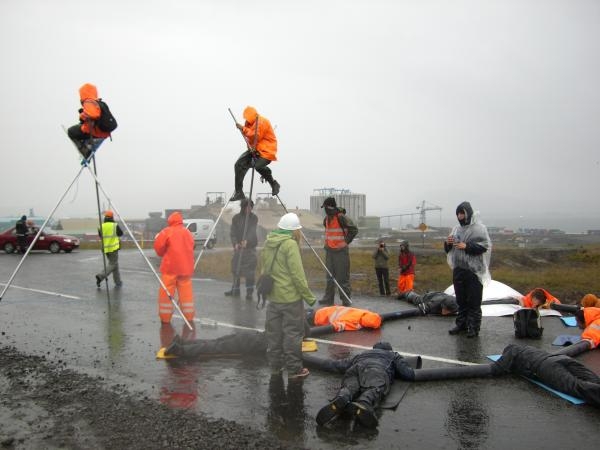
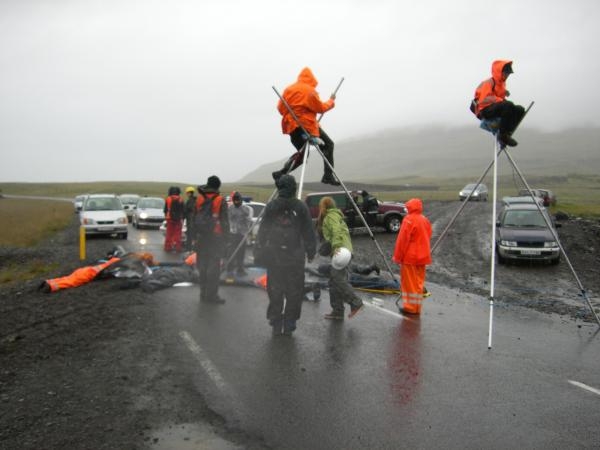
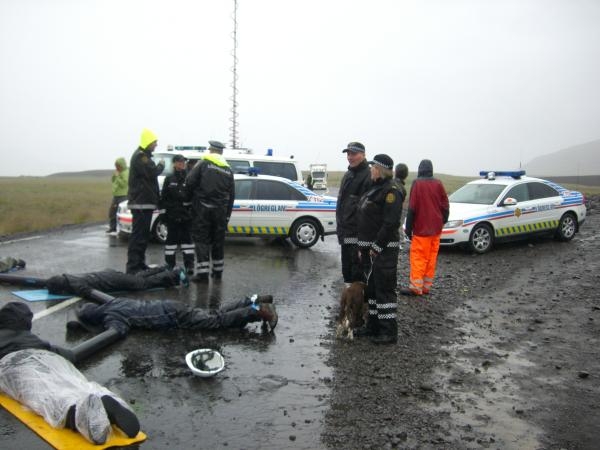
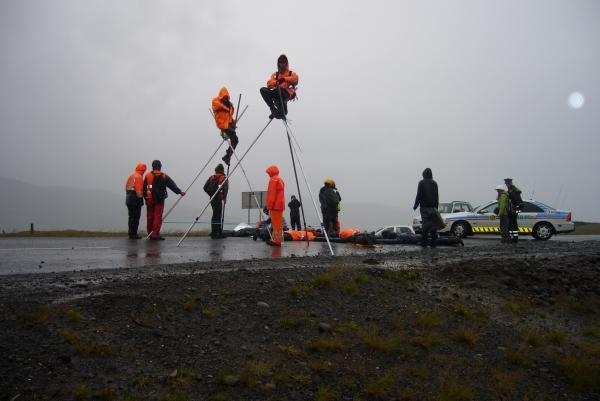
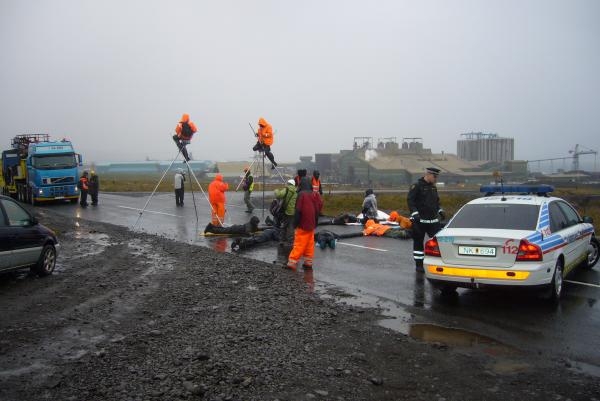
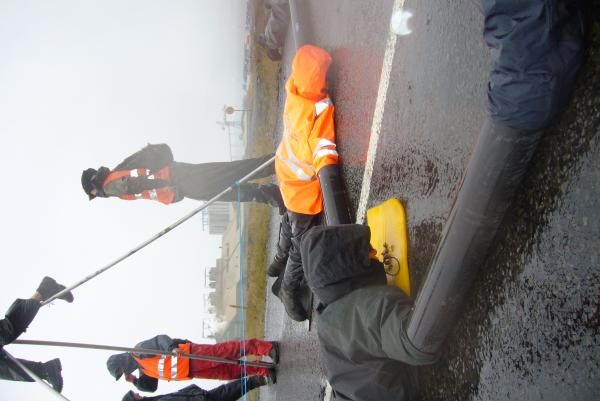
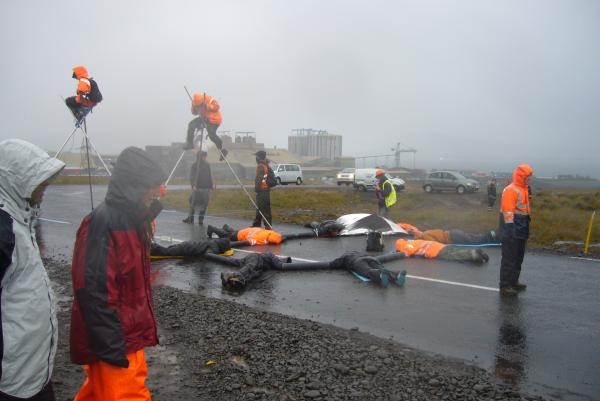
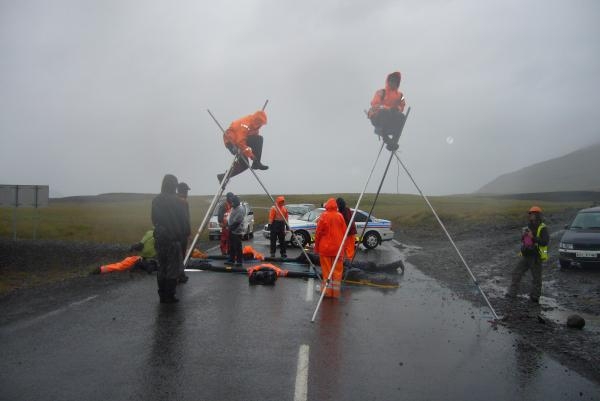
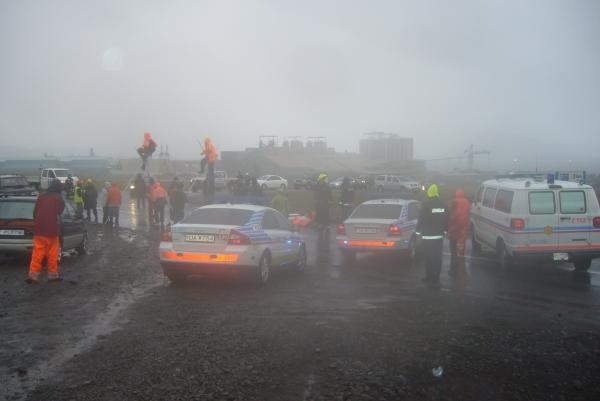
GRUNDARTANGI – Today 20 activists from Saving Iceland blockaded the single supply road to Century Aluminum’s smelter on Hvalfjordur and Elkem – Icelandic Alloys steel factory. They have chained themselves to each other using arm tubes to form a human blockade as well as using tripod for the first time in Icelandic history.
The blockade went on for three hours. Nobody was arrested. “We protest the environmental and human health hazards Century’s bauxite mining and refining activities in Jamaica, their plans for a new smelter and refinery in West Congo. Both Century’s and Elkem’s expansion plans will also mean destruction of unique geothermal areas in Iceland and produce large amounts of greenhouse gas emissions,” says Miriam Rose of Saving Iceland (1).


Century in West-Congo: opencast bauxite mining
In 2007 Century Aluminum Company signed a memorandum of understanding (MOU) with the Republic of the Congo (ROC) for the exclusive right to develop an aluminium smelter, alumina refinery and a bauxite mine (2). It specifies a minimum commitment of 500 megawatts of gas-generated electrical energy. Century is surveying where to mine the bauxite and will start building the smelter as soon as possible (3).

“We believe that the Republic of the Congo has all of the ingredients necessary to sustain a profitable aluminum industry,” said Century CEO Logan W. Kruger (2).

“Kruger is right,” says Snorri Páll Jónsson Úlfhildarson of Saving Iceland. “Transparency International rated the ROC as one of the most corrupt regimes in the world. Exactly the kind of regimes aluminium corporations like to deal with…” (4)

“It’s very unlikely the poor will have any benefit from this development but they will pay the price of the environmental impact. Oil revenue in the country has never reached them, why would it be different for bauxite?” Úlfhildarson continues.

“Considering the bauxite reserves in West Congo, it is clear that Century is planning large scale open cast mining there, in the same way other corporations are attempting in Orissa and what has also happened in Jamaica, Guyana and Guinea,” says Indian aluminium expert and author Samarendra Das who will be talking on this topic at Reykjavik Academia on Wednesday (see note a.).

“All over the world, where bauxite is mined the environment is being destroyed and people’s livelihoods and health taken away from them. People in Iceland need to know where the bauxite that is refined and then smelted into aluminium comes from,” says Das.


Century in Jamaica: environmental and health hazards
Century-owned St Ann Bauxite, it’s predecessor Kaiser as well as the ALCOA, RioTinto-Alcan and Rusal (which owns 1/3 of Century), are also active in Jamaica, have been held responsible for rainforest being destroyed and toxic pollution of drinking water (5,6,7). Century want to open up a second mine and refinery in a joint venture with Chinese Minmetals. That company is associated with prison labour factories and gross human rights abuses in China and elsewhere (see note b.).


Elkem – Icelandic Alloys: pollution accidents every week
Elkem - Icelandic Alloys wants to expand its facility at Grundartangi on Hvalfjordur for producing ferrosilicon for the steel industry. It is already one of Iceland’s largest contributors to greenhouse gases and other pollutants; expansion of the smelter would lead to a significant increase in Iceland’s carbon emissions (1).

In July 2007 it was reported (8) that Elkem ‘accidentally’ released a huge cloud of pollution from their plant. Apparently the accident was due to human error. Thordur Magnusson, an Elkem spokesman, then said that this human error “recurs several times a week.” Sigurbjorn Hjaltason, chairman of Kjosarhreppur parish, said that Elkem usually produced the emissions at night throughout the year.


About Saving Iceland
Last Friday, Saving Iceland stopped work at the construction site of Century Aluminum’s planned new smelter in Helguvík. This is part of their fourth summer of direct action against heavy industry in Iceland. In July 2007 activists also blockaded the smelter and steel factory.

Saving Iceland was started by Icelandic environmentalists asking for help to protest the Icelandic wilderness, the largest remaining in Europe, from heavy industry. As well as Century, other aluminium corporations ALCOA and Rio Tinto-Alcan want to construct new smelters. This would require exploitation of all the geothermal areas in the country, as well as damming all major glacial rivers (see note c.).

This year, the fourth action camp to protect Icelandic nature has been set up near the Hellisheidi geothermal plant east of Reykjavik, which is currently being expanded to produce electricity for Century Aluminum.

More information with a video of the actions
http://www.savingiceland.org
savingiceland at riseup.net

Notes
A.) On Wednesday July 23, 19.30 h. Saving Iceland and Futureland will hold a conference with the Indian writer, scientist and aluminium expert Samarendra Das and ‘Dreamland’ author Andri Snær Magnusson, on the influence of the aluminium industry in the third world. Also, the concept of aluminium as a ‘green’ product will be examined. It will take place at Reykjavik Academia, Hringbraut 121. Mr Das is available for interviews; please contact one of the Saving Iceland contacts above.

B.) In 2004 Minmetals attempted a takeover of Canadian mining company Noranda but were declined in 2005 due to serious concerns over human rights abuses by the Chinese company. This report details Minmetal’s association to forced labour:
Dhir, Aaron A. (2006). ’Of Takeovers, Foreign Investment and Human Rights: Unpacking the Noranda-Minmetals Conundrum’, Banking and Finance Law Review, 22, 77-104.

C.) For more details and an overview of projects in Iceland, see: http://www.savingiceland.org/sos


References
(1) Icelandic Ministry of the Environment (2006). Iceland’s fourth national communication on climate change, report to the UNFCCC. http://unfccc.int/resource/docs/natc/isl… [Accessed 20-6-08]
(2) AZ Materials News (2007). Century Aluminium to Build Aluminium Smelter in Republic of Congo.http://www.azom.com/News.asp?NewsID=7734 [Accessed 20-6-08]
(3) Afrique en Ligne (2008). Congo to build aluminium smelter in Pointe-Noire. http://www.afriquenligne.fr/news/africa-… [Accessed 20-6-08]
(4) Transparency International (2006). Corruption Perceptions Index 2006. Transparency International, Berlin.
(5) Zadie Neufville, April 6, 2001, ’Bauxite Mining Blamed for Deforestation’. See http://forests.org/archive/samerica/baux…. [Accessed 20-6-08]

(6) Mines and Communities report,’Bauxite Mine Fight Looms in Jamaica’s Cockpit Country’, 24th October 2006. http://www.minesandcommunities.org/artic…. [Accessed 20-6-08]

(7) Al Jazeera (2008). Environmental damage from mining in Jamaica, June 11, 2008 News. Available through http://www.youtube.com/watch?v=vJa2ftQwf…. [Accessed 20-6-08]
(8) MBL.is (2007). Reykur frá járnblendiverksmiðjunni Grundartanga. http://mbl.is/mm/frettir/innlent/2007/07… [Accessed 20-6-08]

CIMG0102.JPG
Ipod used for the first time in Icelandic history
CIMG0103.JPG
Saving Iceland Blockades Century Aluminum Smelter and Elkem Steel Factory
CIMG0106.JPG
Saving Iceland Blockades Century Aluminum Smelter and Elkem Steel Factory
P1010083.JPG
Saving Iceland Blockades Century Aluminum Smelter and Elkem Steel Factory
P1010084.JPG
Saving Iceland Blockades Century Aluminum Smelter and Elkem Steel Factory
P1010088.JPG
Saving Iceland Blockades Century Aluminum Smelter and Elkem Steel Factory
P1010091.JPG
Saving Iceland Blockades Century Aluminum Smelter and Elkem Steel Factory
P1010093.JPG
Saving Iceland Blockades Century Aluminum Smelter and Elkem Steel Factory
P1010106.JPG
Saving Iceland Blockades Century Aluminum Smelter and Elkem Steel Factory

Video: Visit to an aluminium smelter

Random video in Youtube

Thursday, February 16, 2012

Web: Animal poisoning raises controversy near Irish Aluminum Smelter

Animal poisoning raises controversy near Irish Aluminum Smelter

The Irish Times
04/15/1995
Agencies move to unravel mystery of animal deaths
This week the Environmental Protection Agency and three other State agencies announced their plans to investigate unexplained animal deaths in West Limerick
by Catherine Cleary
See original article


"I GOT all this equipment years ago and never thought I'd be using it for this," Justin Ryan says as he takes a tape out of his camcorder. He has been using it to record the sick and dying animals on his farm and neighbouring farms near Askeaton, Co Limerick.

Mr Ryan sent a copy of his video to the Minister for Agriculture, Food and Forestry, Mr Ivan Yates recently. It makes for gruesome viewing. In their last days the animals look more like cattle in a famine area than in one of the more fertile areas of the country. Some have raw wounds on their joints where lesions have formed. One cow is collapsed forward unable to lift herself off her knees, while part of another animal's hide hangs off in tatters. Last Monday, Mr 
Ryan buried another dead cow, the 16th to die this year. The carcass lay in the field for a week but was left untouched by the birds. Even the eyes were intact, he says. In a life time of farming he has never seen this happen. The Department of Agriculture post mortem reports on some of the cattle deaths said that the organs of two of the cows were too badly decomposed to be examined. Mr Ryan believes his cattle are being "eaten up from inside".

The three worst affected farmers in the area Justin Ryan, Liam Somers and a farmer who would not be named "in case we lose what's left of our livelihood" have lost more than 150 animals between them since the problems started in the late 1980s. It is reported that up to 17 other farms in the area are also affected.

IN February the local animal health group sent samples of milk from three dairy herds in the area to a UK testing agency. The tests found six times the normal concentration of aluminium in one of the samples. Mr Donagh O'Grady, of the animal health group, admitted that this was a small scale test. At a public meeting with the Environmental Protection Agency in Askeaton last Tuesday night, Ms Marie Sherwood, of the EPA, said that the levels did not exceed the accepted levels in drinking water.

Her assurances met with a lukewarm reception from over 3,00 people who attended the meeting. "We don't know what's killing the cows and we don't know if what's killing the cows is going to kill us," came one comment from the floor. It was followed by a rousing burst of applause. It is not just the farmers around Askeaton who are worried. Local people are getting worried about the air they share with the dying animals.

At the meeting, the assembled panel of experts from the EPA, Teagasc, the Department of Agriculture and the Mid Western Health Board (MWHB), outlined the scope of their investigations. Only Teagasc, the state agriculture development board, gave a deadline for the completion of their study of soil and plant samples. They expect to be finished by the end of September,

The studies will attempt to plug the gap between the evidence of dead animals and scientific proof of the cause, according to the EPA. P.J. O'Connor from the Department of Agriculture, described the process as painstaking and systematic. "It's going to be lengthy," he said. The MWHB will also look at the human health implications. Dr Mary O'Mahoney, of the MWHB, said that in an initial survey GPs in the area had reported no signs of a cluster of "adverse health effects" in the area.

However, according to Mr Ryan, his two year old son developed a skin rash which cleared up when he was taken off the milk produced on the firm. The local co-op collects the milk from the Ryan and Somers farms in an unmarked lorry. Recently the co-op confirmed that it was dumping the milk.

At the meeting local people spoke about experiencing a burning sensation on the face, lips and throat on certain days. One woman said that both her children had recently developed asthma. Another woman said that the sensation on some days was like "having someone holding on to your lungs".

According to the EPA there is limited evidence on which to investigate these claims. Mr Michael McGettigan, of the EPA, said that its air pollution tests will cover all the industrial sources in the area, "both those which are readily visible on the skyline and those which may not be so visible".

From the top of Liam Somers's farm on a clear day the skyline takes in the smoke stacks of Aughinish Alumina and, in the far distance, the ESB stations, Moneypoint and Tarbert. The nearest, Aughinish, is about 3 1/2 miles from his farm, as the crow flies.

In the middle of the field on the Somers's farm a small corrugated iron shed hums. It was erected a year ago by Limerick County Council to monitor sulphur dioxide levels. Results showed a 48 per cent increase, according to Mr Somers. The EPA is planning to upgrade this monitoring by checking at hourly, rather than daily intervals. And it will also attempt to pinpoint the direction of deposits, as well as deposits of aluminium, fluoride and organic compounds.

MR SOMERS has lost 89 animals since the spring of 1988. More than 40 calves died seconds after being born covered in a jelly like mucus, he says. He has seen grass on his land turn pink, purple and then brown. He and his family also suffer recurring skin problems.

In August 1994, Aughinish Alumina put forward a proposal for testing the cause of the animal deaths. In a final clause it was stated that the results were to be kept within the committee and only reported to Liam Somers or his vet, John O'Mahoney, if they were "demanded by legal subpoena". After taking legal advice Mr Somers refused to co-operate with the tests. The public relations officer of Aughinish Alumina, Mr Pat Lynch, describes this as a "misunderstanding over one clause that should never have gone in."

Mr Somers is collecting reports and information on the complex chemical cocktail that he believes is poisoning his animals, while Mr Ryan says he has been in touch with German environmentalists; they may consider taking a case against the State to Europe.

At the Aughinish Alumina plant a digital readout board at the entrance proclaims that day's production rate. On Tuesday it was 2,095 tonnes, 6,546 tonnes behind the "1.18m tonne status". According to Mr Lynch, Aughinish's role now is "to pull back from the limelight and let the independent bodies get on with it"

Meanwhile Mr Ryan is getting used to burying dead cows. "This time last year it was devastating, but now it's normal routine."
******************************************

The Irish Times
December 15, 1995
Interim EPA report says animal deaths on two Limerick farms a mystery
By CATHERINE CLEARY

AFTER more than six months of investigations coordinated by the Environmental Protection Agency, the animal deaths on two Limerick farms remain a mystery.
In an interim report published yesterday the EPA said its observations had provided "no evidence of significant pollution in the area."

The farms are about eight kilometres from the Aughinish Alumina plant and further west there are two ESB plants, Moneypoint and Tarbert. The three plants together emitted 5 per cent of the national annual sulphur dioxide emissions between 1988 and 1994, according to the report. The cost of the separate investigations, by the Department of Agriculture, the Mid Western Health Board, Teagasc and the EPA, is likely to run into millions.

Last month, the Department bought one of the worst affected fans for Pounds 1 million, to carry out veterinary studies, and is leasing the other farm from its owner, Mr Liam Somers. The dairy farmers have lost almost 200 cattle between them in seven years.

Local reports of human health problems have not been supported by an initial survey of GPs. 
According to the EPA the health board is to study incidences of cancers, miscarriages and twinning in the area.

"In addition there will be a systematic study of acute health defects such as respiratory problems and skin rashes," it said. These human health studies will probably take two years to complete.

The report said the EPA agreed with a review by the American EPA which found that milk from farms in the area was "safe to drink in terms of exposure to aluminium and fluoride."

In its studies of plant, soil and water, Teagasc found little change in sulphur levels in the grass and plants compared to a baseline survey carried out in the 1970s. However, a study carried out last year found high levels of sulphur.

According to EPA programme manager. Dr Paul Toner, more detailed work will be done on the sulphur deposits. "A number of things have now been written out. We have ruled out dioxins but we wouldn't have expected them."

Teagasc has completed its plant, soil and water studies, according to the EPA, although further studies will be done. The animal and human health studies are not expected to be completed before the end of 1997.

Last February the Minister for Agriculture, Mr Yates, invited the EPA to coordinate a general investigation.

Teagasc began taking samples on the two farms and a third control farm in the area in April. It concluded the study in September. According to the report, it found levels of copper, iodine, selenium and zinc which were "less than optimum for animal health".

"A few results were at the extremes of the typical ranges, in particular the fluoride concentrations in the soils. The high values recorded for the latter seem to reflect the naturally raised levels of fluoride in this area of Co Limerick," it said.

Dr Toner said the EPA had charted the hourly averages of sulphur content in the air. "There were short lived peaks and the hourly values can certainly exceed the daily levels, but these are still below the World Health Organisation safe limits."

He said the highest peak had been recorded on the control farm, but it was difficult to identify the source.

Dr Toner said the EPA was not ruling out a pollution involvement, "but it wouldn't be unusual in these situations not to have a clear cut answer."

Aughinish Alumina had applied for an Integrated Pollution Control licence from the EPA.

"People in the area are against them getting a licence but there is nothing in our data to involve them." He said sulphur dioxide levels were "nowhere near the levels that would cause, the problems that are out there.

The report recommends that local vets should contact the regional veterinary laboratory and that the Department of Agriculture should have access to veterinary toxicological expertise.
The report also recommended that statutory arrangements be put in place to allow access to farms for future investigations.
******************************************

The Irish Times
August 10, 2001
'No evidence' that environment had caused ill health
By DECLAN FAHY

Two Co Limerick farmers reported unusually high levels of animal health problems on their farms in the late 1980s and early 1990s.

Mr Liam Somers and Mr Justin Ryan reported, among other things, that calves were dying and cows were in extremely poor health.

Reports of problems on 25 other farms followed, with concerns about the level of human illness in the area.

The EPA report into the animal health problems in the area looked in detail at research findings in four areas as detailed below.

Human Health

Locals in Askeaton expressed concern about the number of miscarriages, foetal abnormalities and the incidences of cancer in their area. There were reports from locals of skin, eye and respiratory problems. There were also fears environmental pollution was involved.
In their conclusions, investigators said "this study has not found a significant degree of excessive ill health in the Askeaton area".

The study has "not found an explicit link between pollution and ill-health". It did find a "mild excess" in the people who report themselves as being ill. A GP study also found people in the area had "proportionally more worries about rates of miscarriage, serious illness and patient health".

There was no evidence of "an excess of cancer incidence in the risk area" and the study found a "significantly lower level of cancer in the risk area" compared with the MWHB area and the rest of the State. Three birthing studies found no evidence of abnormal ill health.

Animal Health

Problems on the Somers farm were reported to have begun around 1988. The main animal health issues reported were infertility, mortality in cows and growing stock, perinatal calf mortality, diarrhoea in calves and skin lesions in cows and cattle.

Severe animal health problems were reported on the Ryan farm in 1994 and 1995, the main being a high incidence of cows being in poor condition, illness and mortality in cows and growing cattle, abortion, calving difficulty, infertility, and illness and death in calves.

The report said Mr Somers, Mr Ryan and about 4,000 people in the area felt environmental pollution was the key cause of these animal health problems.

The report concluded that certain farms in the area, including the Ryan and Somers farms, had "an unusually high incidence of animal disease and production problems at times from 1988 to 1995".

But there was "little evidence" to suggest this was part of a problem in the wider area, or that "unusual underlying factors, such as environmental pollution, were responsible".

Overall, there was nothing to suggest factors other than those normally considered - "nutrition, management and infectious agents" - needed to be "cited to account for disease incidence in the Askeaton area".

Environmental Quality

Locals said the animal health problems, and the concerns over human health, were caused by environmental pollution, in particular emissions from alumina production at Aughinish Alumina Ltd (AAL), which is located eight kilometres west of the affected farms.

There are also two major ESB plants, Moneypoint and Tarbet, near the affected farms.

Among the pollutants which were suspected to be responsible were aluminium and fluoride, as well as organic compounds such as dioxins and PCBs.

These suspicions were based on information from scientific literature, not from any record of contamination in the area.

The report said "the available data indicate that the Askeaton area was not subject to harmful levels of pollutants during the period of the investigation and this was the position at least since the mid-1980s".

Levels of pollutants measured from the industries were within existing safety limits, the report found.

Soil, Herbage, Feed And Water
Soil was analysed to find evidence of previous inputs that may have contributed to animal health problems at the Somers and Ryan farms. The report found there was "no evidence that soils were contaminated" by elements deposited by pollution washed out of the atmosphere.